There’s a version of this conversation that gets had a lot in marketing departments. Someone comes back from a conference or reads an article and says “we should be doing intelligent SEO” and then nobody is quite sure what that means in practice, whether the current agency is doing it, or whether it’s worth paying extra for.
Let me try to make it concrete.
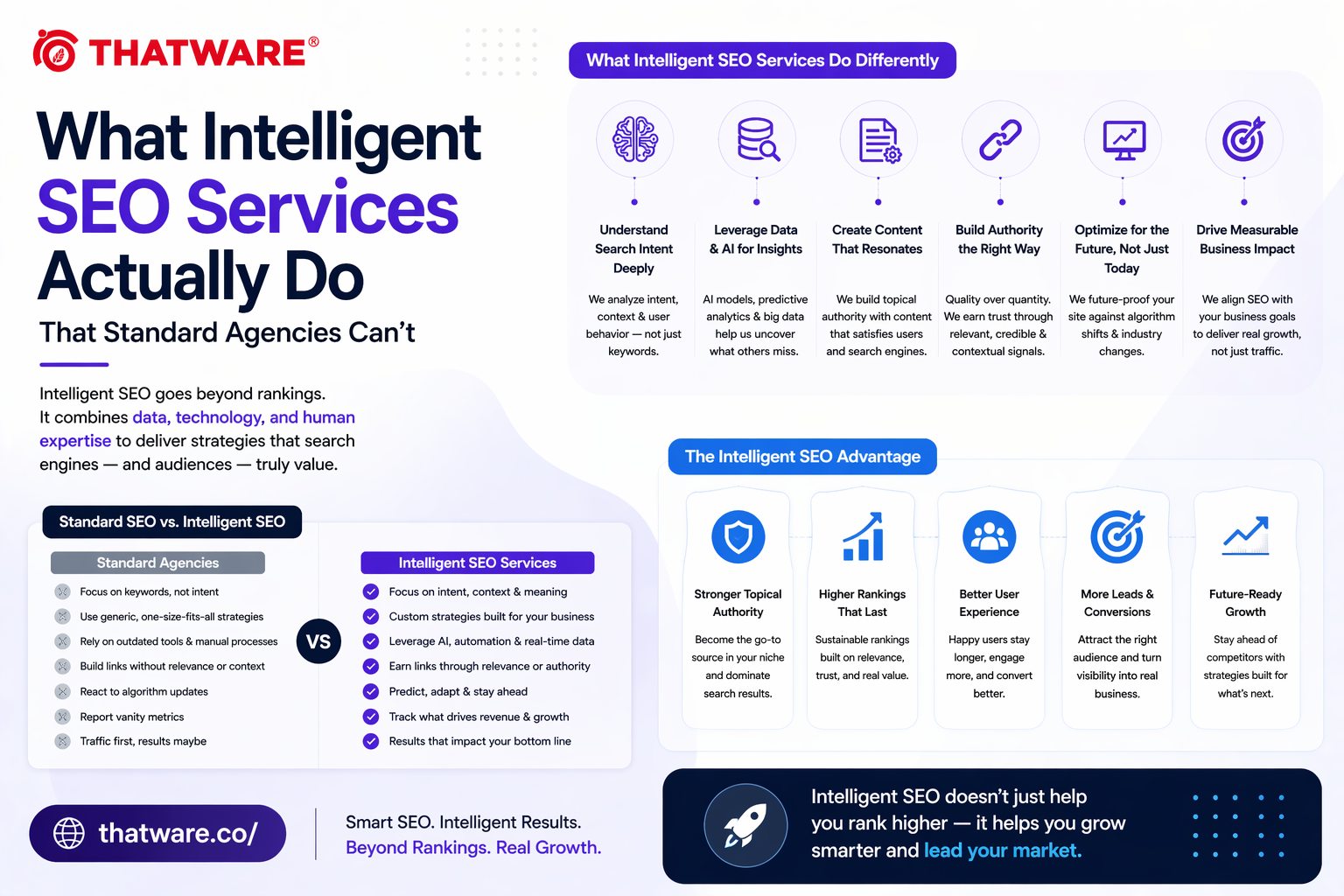
Standard SEO agencies, the good ones, do the fundamentals well. They audit technical issues, fix crawl problems, research keywords, create content briefs, build links through outreach, and track rankings. These things matter and a competent agency executing them well will produce real results for most businesses.
What they’re generally not doing is applying machine learning-driven analysis to identify patterns across large datasets that human analysis can’t efficiently process. They’re not synthesizing signals from user behavior, SERP dynamics, content performance, and competitive movement simultaneously to identify strategic opportunities. They’re not modeling how search behavior will likely shift based on upstream signals in Google’s research and quality evaluations. And they’re not approaching the AI-mediated layer of search as a distinct optimization target with its own analytical framework.
These aren’t limitations of effort or talent. They’re limitations of methodology and infrastructure. Standard SEO operates primarily with human analysis augmented by standard tools. Intelligent SEO applies machine learning systems that can process and synthesize data at a scale and speed that changes what analysis is possible.
What does that difference look like in outcomes? A few specific examples.
Content gap identification. Standard process: keyword research tools, competitive analysis, manual review of competitors’ content. Intelligent process: machine learning analysis of the topical coverage across the entire competitive landscape, identifying not just which keywords are uncovered but which topical relationships and entity clusters are missing from the site’s content graph, mapped against what AI systems draw from for the relevant category.
Technical prioritization. Standard process: crawl audit identifies issues, analyst prioritizes by general impact category. Intelligent process: log file analysis combined with ranking data, crawl budget modeling, and revenue attribution to identify precisely which technical issues are measurably limiting organic performance and in what order fixing them will produce ROI.
Link opportunity evaluation. Standard process: domain authority metrics, topical relevance assessment, manual outreach. Intelligent process: link profile analysis against patterns that correlate with ranking performance in the specific competitive context, identifying the specific authority gaps that are limiting the site’s competitive position.
intelligent seo services are not appropriate for every business at every stage. If you’re still working through basic technical issues, haven’t established clear topical authority in your core subject areas, and are producing a modest volume of content, the marginal value of sophisticated AI-driven analysis is lower. The infrastructure and investment make more sense when the fundamentals are solid and the optimization challenge has become genuinely complex.
A cognitive intelligence seo agency operating at a high level will be honest about this. They’ll assess whether the sophistication of their approach is warranted for your current situation or whether the immediate priority is foundational work that doesn’t require their most advanced capabilities. That honesty is itself a quality signal.
The businesses that benefit most from intelligent SEO services tend to be: enterprises with complex sites and high SEO revenue dependence, businesses in hyper-competitive verticals where marginal analytical advantage matters, and organizations that have plateaued on standard SEO approaches and need a different kind of analysis to identify what’s holding performance back.
For everyone else: focus on the fundamentals, work with an agency that executes them well, and understand that intelligence and sophistication in SEO create value on top of a solid base, not as a substitute for one.